COMPONENT: JEANNE D'ARC
TOPIC: L'HEXAGON (France)
VISITOR: ELEANOR OF AQUITAINE
TOPIC: L'HEXAGON (France)
VISITOR: ELEANOR OF AQUITAINE
Eleanor of Aquitaine was the wife of two kings, one French and one English, and the mother of two kings, Richard the Lionheart and King John who signed the Magna Carta. As an intro to her visit, I taught the kids to sing a song that Autumn and Giselle and I learned in school years before, Savez-vous Plantez les Choux (Do You Know How to Plant Cabbages?) It's a fun song to sing!    After peer reviews, the older kids helped out with the inquiries. At one rotation the students learned how to write poetry in the triolet form, a kind of poetry that Eleanor enjoyed. After writing a triolet poem, the students donned a troubadour collar and hat, and recited their poems Queen Eleanor:  The students enjoyed singing the queen's praises, medieval style!  A cute, little troubadour--   GETTY ART MUSEUM, LOS ANGELES The next day Giselle and I went to the Getty to see an exhibit of illuminated manuscripts.  I'm always looking for reasons to visit places like the Getty. This was it!  It's fun being on adventures with someone who's as passionate about art as I am.  LE LIVRE DE MORMON Our family officially finished reading Le Livre de Mormon, The Book of Mormon in French March 18, 2012, right in the middle of our study of France and Joan of Arc. We began reading it in August 2008 while Autumn was still home. I was surprised how quickly the girls picked up the ability to translate a verse into English. This helped Autumn later when she was called to the France, Paris mission. I don't remember which prophet told us that if we read The Book of Mormon in another language, we would learn the language faster. I know that's a true promise because I saw it happen. I've read others' experiences with this as well. It's supposed to be one of the best English as a Second Language courses. The Book of Mormon App is free too, so that's a pretty cheap language course. The Book of Mormon is the word of God and Another Testament of Jesus Christ, no matter the language. I'm thankful that we could read it in French as a family.  COMPONENT: JEANNE D'ARC TOPIC: GOTHIC GARGOYLES AND GRIFFINS VISITOR: GARGOYLE VICTOR Katy was the gargoyle, Victor, (as in Hugo), for our topic, Gothic Gargoyles and Griffins, the study of medieval cathedrals. A short time later when Giselle and I were at Disneyland, she pointed out that the scary creatures at the Haunted Mansion were not really gargoyles, they're grotesques because they don't spout water like gargoyles do. Of course, she learned this from Katy's key points that day.    FIELD TRIP: JUDD STAINED GLASS STUDIO and GLENDALE FOREST LAWN  We toured the studio and watched the artists. I didn't realize how much stained glass is still being made in modern times.  It was wonderful to see the process from artwork and computer design, to the finished product.  The lead surrounding the stained glass has to be replaced about every 50 years because it melts and sags. We watched artists from several countries painting glass and repairing cathedral and other stained glass. After the tour at the studio, we headed to Glendale Forest Lawn to see the exhibit of medieval and other stained glass in the gift shop.  Giselle found a statue of Joan of Arc in the gift shop too.  Right next to the museum is the Hall of Crucifixion and Resurrection, which houses the largest religious painting in the world. It's a beautiful, medieval-looking building, inside and out.   The other things I wanted to see at Forest Lawn were the replicas of two medieval British churches. During the Austen/Dickens' school year Katy and Giselle sat in this same Wishing Chair on the day of our Tale of Two Cities book discussion. The stones of the chair are made of stones from the original church in Scotland.  It was a beautiful day with Southern California weather, and gorgeous art and architecture!   JEANNE D'ARC PROJECTS AND CLOSING DAY For the last two years, Giselle has written an EPIC Adventure for an end-of-year project. This year she decided to turn her Joan of Arc research into an illustrated children's book. .jpg)  After scanning her artwork and importing it into her story, she found places that needed more artwork, so she drew more.  One day Karen was visiting while Giselle was working on her book. When she saw Giselle's room she said, "This isn't a messy room, this is a room of creativity and work."   Although Giselle spent many, many hours putting her book together, she did feel rushed due to the closing day presentation deadline. When she shared her regret with me that the book wasn't exactly as perfect as she would have liked, I reminded her of something Karen once told me, "Sometimes 'done' is better than 'perfect.' " We met at our stage which was still decorated from our Everyman play. I asked Lorenzo to be our herald for the day and announce the presentations. He had been so quiet when I met him the year before, but he bloomed and took on tasks like a pro.  Two of Karen's grandchildren, ages 7 and 5, shared their reenactment of Giselle's Joan of Arc day. It was so sweet to see what they did. After watching Giselle as Joan of Arc, they went home and set up 11 stations and acted out the story of Joan's life.  The stations they set up in their backyard: Station 1 - An introduction of Joan of Arc. Station 2 - Costumes. How to train and care for a horse. Instruction for farming. Station 3 - Trip to the blacksmith to get armor. Station 4 - Knight's training to prepare for battle. Station 5 - Camping on the battle trail, including a campfire, catching and cooking dinner, sleeping and early rise for battle. Station 6 - Battle of Orleans Station 7 - Crowning the Dauphin Station 8 - Battle with the Burgundians and English. Station 9 - Prison. Joan jumping out of the prison window. Joan in prison without a window Station 10 - Burned at the Stake Station 11 - Photos with Joan Karen said, "The production was in full costume... It was a tribute to the power of example, their inspired achievement ignited by the example of an older student."  Giselle dressed up again as Joan, and presented her book. She told how she put it together, and shared a few of her drawings.     Several families asked to purchase a copy of her book on condition that she add a photo of herself as Joan the Maid, and also autograph it.  The projects presented by the students:
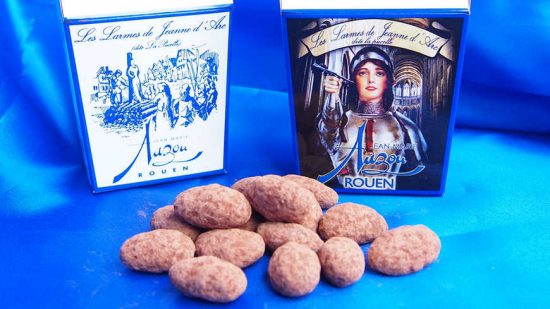
  My friend Joan, who was named for Saint Joan, came to our closing day and brought along homemade Larmes de Jeanne d'Arc, (Tears of Joan of Arc), for everyone. These almond candies originated in Rouen, France, where Joan of Arc died.
As a token of the day I printed small cards of Giselle's main drawing of Joan, and added a ribbon with a piece of Giselle's chainmail attached. Students and moms could glue them into their Journals of Discovery, which is where I put mine.  A few days later Giselle printed the requested copies.   One last photo--goodbye to our beautiful stage.  Karen was so impressed with Giselle. She asked me to write several articles for her blog, and added her commentary about Giselle: THE EPIC PATTERN OF A SCHOLAR Afterword by Karen: The EPIC Pattern of a true Scholar was perfectly illustrated in Giselle's whole journey as Joan of Arc.
E - EXPOSURE
P - PATTERNS
I - INQUIRY
C - CONTRIBUTION
This is the pattern of a true scholar, from the interest ignited by exposure to the purpose embodied by real contribution. Learning is more than reading a book, answering questions and writing a paper. I share often what Howard Gardner points out, "intelligence is a problem-solving, product-producing capability." True learning is engaging, comprehensive, far-reaching.  |



No comments:
Post a Comment